

That’s not a comfortable question, and it isn’t meant to be. But it’s the first one, and answering it honestly is what makes every later decision real.
 Some people want a tool that controls and escapes — that stops the threat, creates the gap, and lets them get to safety. Some people want more available to them than that. Both answers are legitimate. What isn’t legitimate is not having thought about it, then discovering your answer in the middle of an assault.
The Defender line is organized into three levels so you can choose deliberately:
Everyday Carry — small, light, built for control and escape. Rides in a pocket, on a keychain, in your hand. The most force most people will ever need.
Aggressive — more forward geometry, more available options. For someone who has decided they want a wider range of responses available.
Extremely Aggressive — the most capable tools in the line. Chosen deliberately by people who have thought hard about the level they’re willing to operate at.
There is no right rung on this ladder. There is only the rung that’s honestly yours. Pick below your conviction and you’ll hesitate. Pick above it and you’ll carry something you don’t want to use.
 Most people who carry a self-defense tool couldn’t tell you how it actually works. They know it’s there. They’ve imagined using it. But they’ve never been told what the geometry is for.
Every Defender is a set of surfaces, and each surface does a specific job.
Squared grip surfaces give the tool somewhere to bite — spaced unevenly on purpose, because uneven spacing grabs a far wider range of shapes and surfaces than an even pattern does.
The talon is a single curved hook that concentrates leverage into one point. It’s what lets you steer someone off you, break a hold, or take away a grip. It doesn’t require strength. It requires a place to push against.
The digit-capture hole captures a finger or thumb between the tool and your grip. Once caught at two points that can’t move independently, letting go stops being the attacker’s decision.
The hammer end is kinetic — a narrow edge on a quarter-inch of material, which concentrates a light swing into enormous pressure against hard, bony structure.
Underneath all of it is one idea: structure instead of strength. A physical plane to push against. This is why a smaller person can control a larger attacker with a 1.6-ounce piece of acrylic — not by overpowering anyone, but by giving themselves places to move that change what the attacker is able to do.
Understand that and you’re carrying a tool. Skip it and you’re carrying an object.
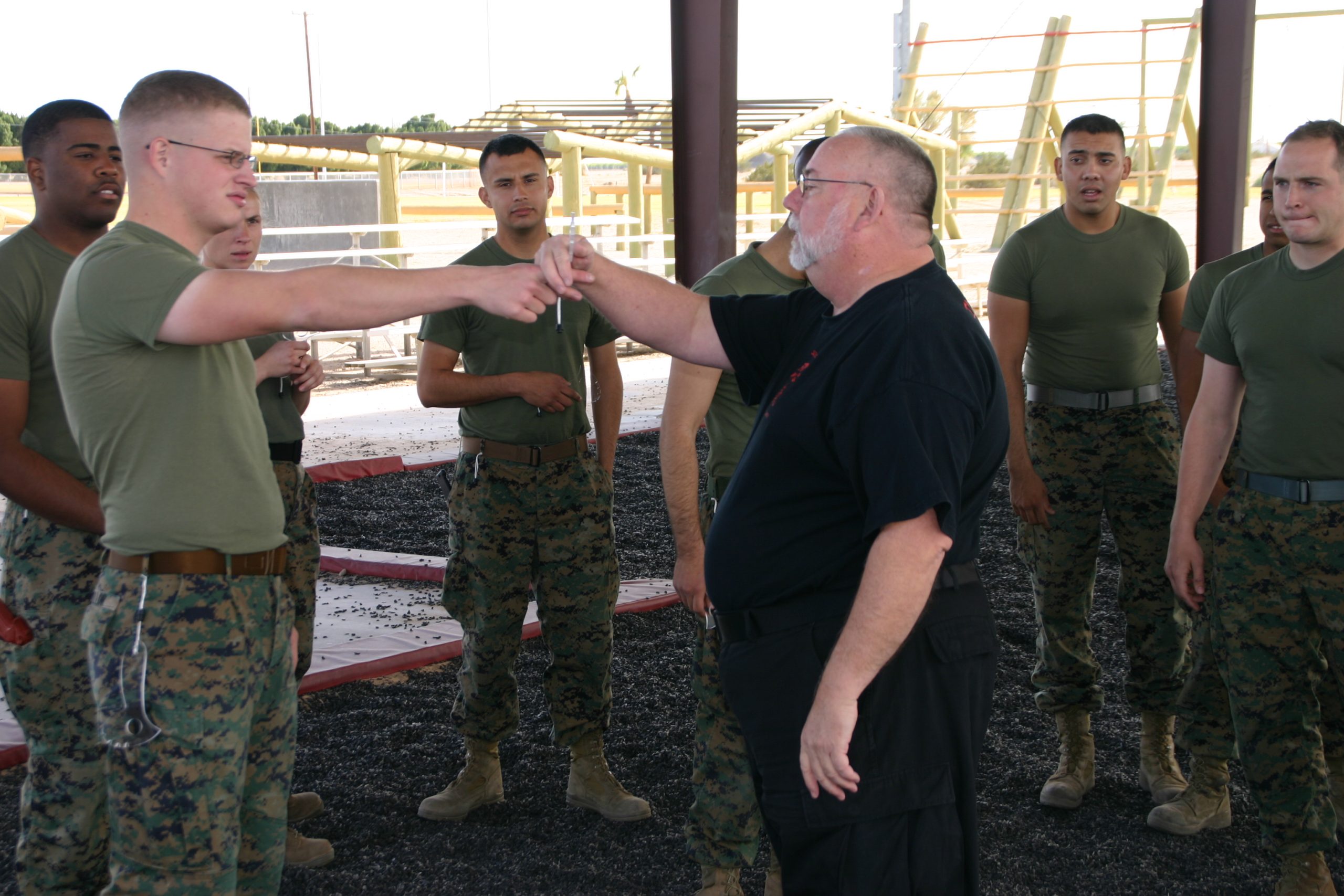 Knowing what a tool does and being able to do it are separated by repetition. That gap doesn’t close by reading, and it doesn’t close by intending to practice.
Here’s why it matters more than people expect. When the adrenaline hits, you lose access to anything you have to think your way through. What remains is what you’ve drilled — movements your body can produce without consulting you. A technique you understand but have never performed is not available to you in an emergency. It’s a memory, not a skill.
This is also why every technique taught here is gross motor. Complex sequences with multiple precise steps look impressive and disappear under stress. Big, simple, powerful movements survive.
The training is free. All of it, forever, with no expiration and no limit. Full video instruction covering every tool in the line and the techniques behind it. There’s no course to buy, no tier to upgrade to, no account required.
That’s a deliberate decision. A tool sold without training is a product. A tool sold with training is protection. I’d rather you drill the movement a hundred times than own a second Defender.

This is the step almost everyone gets wrong, and it’s the one that decides whether the first three mattered.
Run every carry method against the one test: can I do this with shaking hands and tunnel vision?
Digging in a purse fails. Unzipping a pocket fails. Unclipping a retention strap with your fingertips fails. Any method that requires you to find something small, work a fastener, or perform a precise sequence fails — not because you’re not capable, but because the capability you’d need is the exact capability fear takes away first.
What passes is anything that’s already in your hand, or that comes out with one gross motion.
Already in your hand — the Ivan is built entirely around this. No holster, no clip, no lanyard holes, because it isn’t meant to be retrieved. It rides on a split ring and you carry it in your hand when you’re already alert.
One gross motion — a neck rig draws straight down with a whole-arm movement. A Kydex holster on a robust clip pulls clean with a closed fist. A break-away wrist rig keeps the tool tethered to you while your hands stay busy, and releases under one hard pull.
Grip tape belongs here too. The most important part of any tool is the handle, and hands that are wet, gloved, cold, or taking a hit lose their grip long before they lose their will.
Now look back at step one. Your carry method narrows what you can choose — a neck rig or Kydex holster needs a digit-capture hole, which rules out several models before you’ve read a single product page. That’s why this is a loop and not a list. How you’ll carry it is part of deciding what to carry.

