

Best self-defense knife
Introduction
Everyone has their own likes and dislikes for a blade, who makes it, and such. So, bear this in mind as we look at what I consider good EDC close quarters combat knives.
The latter requires particular outcomes that an ordinary utility knife might not deliver. Given enough time and access to an opponent, almost anything can kill them. However, to protect you quickly and allow you to make instant decisions that last a lifetime, well, that takes, in my humble opinion, particular blade features, not to mention the handle.
The most important aspect of a knife
The Handle
When I give my “Anatomy of a knife talk,” it starts with the question of what the most important part of a knife is. Well, you can guess there are many different answers, but the right one is the handle. Why? If you can’t hold onto the knife, then what good is the blade?
So many knives have slippery handles, exotic materials, and such, but in combat situations, you want something you can hang onto during the fight. If it gets bloody, and it will, can you hold onto it? Also, if the handle is part of a folder knife design, how strong is it? Will the handle break off the blade under vigorous use? It happens, and I have seen it.
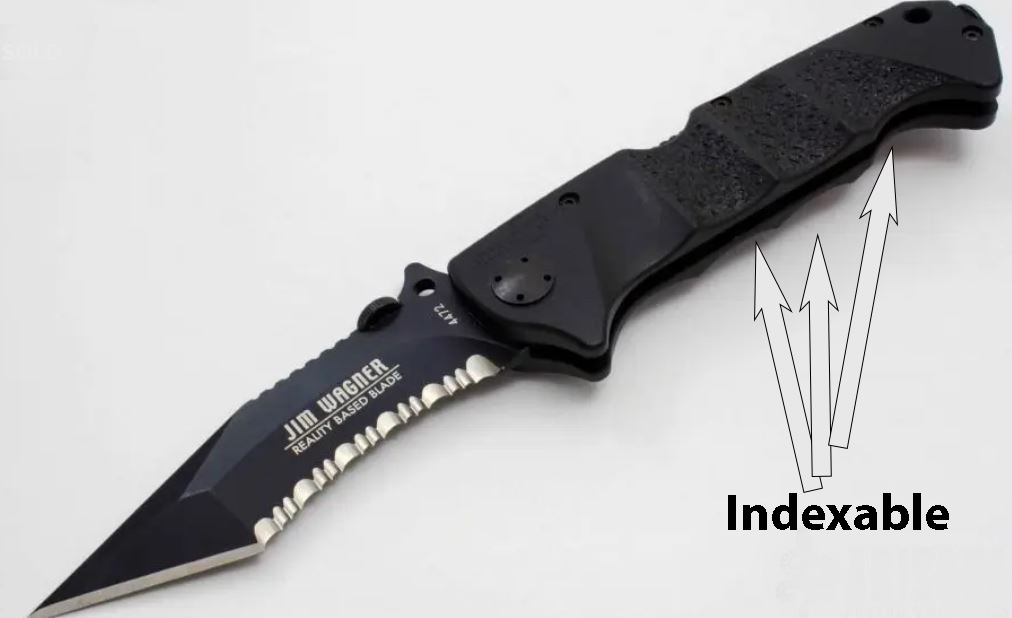
Another significant aspect of handles is whether they are “indexable”? Can the operator know in which direction the blade is just by holding the handle and knowing so without looking at the knife? In the picture above, the handle has finger slots that fit comfortably in one direction and oddly in the other. This is indexable, as you can feel where the finger grooves and the flat handle orient the blade.
This handle feature is a must if you move from the blade forward fighting position or the blade back or in reverse holding position. Are you pointing the blade at the opponent or down your arm? This information comes from your eyes and your touch. If you rely on your eyes only, that means you might need to take your eyes off of your opponent during a fight. That is dangerous and, many times, fatal.
The Blade
The blade will, in most cases, determine the purpose of the knife. A good utility knife has several possible types of blades. Take a skinning knife; it has a particular blade shape that enhances the animal skinning activities of hunters. A fishing knife is very different, and again, other hunting knives are designed to service their hunted prey.
I know my grandfather had a particular type of very thin-bladed pocketknife he loved for cleaning trout. However, my father had a much larger knife for cleaning ducks, pheasants, doves, and quail. Another good family friend had a fishing knife that had places on the blade to facilitate fishing needs—pressing shot onto a line or untangling a ball of line without cutting it. All those are examples of knives born for a purpose.
You see the same thing in the cooking industry. There are many different types of knives made for butchering, cleaning, portioning, and for use at the dinner table. It’s odd to think that the cooking industry might have been where it all began. Sharp stones and sticks were once made to assist in killing game and fish. Later, clean the game, then all the way to serve them on the dinner rock, leaf, plate, or the like.
Fighting knives took their marching orders as a side note, perhaps from the hunting tools of years before, but that is difficult to determine. Tribe-to-tribe conflicts were most certainly resolved by knife, spear, or the like. And look at the many years of humans fighting hand to hand or weapon to weapon.
Weapons were designed in all kinds of ways, from up close and personal to spears, arrows later, and even slingshots. It is fair to say that the design of the fighting knife blade has evolved over thousands of years and continues to this day.
However, for this discussion, we are talking about self-defense and what is the best self-defense knife. This leads us to the two major types of knives and what they bring to the table of self-defense.
The Six Parts of a Knife
The Tip
There are various tip types in the knife world, but in the knife fighting world, there are very few. The reason why is that the tip of the knife is used for stabbing or penetrating the opponent. Historically, the tip was used to penetrate chain armor or between gaps in sheet armor. But we are mostly talking about penetrating leather or clothing to penetrate the opponent. The most important feature in that endeavor is piercing resistance.
Next, we must consider if we have a single blade with one or two cutting surfaces. A dagger knife has two cutting surfaces and thus forms the point that one must work with, which is oddly known as a dagger point, duh. But this fact becomes essential in a short minute here.
So, if forward resistance to a point is what makes it the best stabbing weapon, then by far, a “Tanto” tip is among the top winners. Now, there are several “Tanto” designs depending on the type of blade following the tip. There is your standard “V” blade, or there is a 1/2 the “V” as shown (Chisel Edge Blade) in the following diagram:


In fact, the Chisel Edge blade has one-half the cutting resistance of a standard “V” shaped blade, which is known by many names. But if you look at the geometry of what is going on, you can see that the standard blade cutting has two sides, at some angle, where the tissue must travel up. This causes resistance and thus takes more power to complete the cut. On the other hand, the Chisel edge only has one side, at some angle, that will add resistance to the cutting process. This is also true with a “Tanto” tip, as depending on the attached blade, you will see the same forces at play.
The Blade
As shown above, a Chisel edge has one-half the cutting resistance of a standard blade, and thus, for a fighting knife, it is an excellent choice. Now, if it comes to a sword where you need extreme blade strength, a chisel edge might not be the best choice, but on the other hand, I don’t know any sword with a chisel edge. From weapon to weapon, strength is significant, as well as the point for stabbing.
So, you have the Tanto point for the lowest impact resistance to a stab and a chisel edge blade for one-half the cutting resistance, so what is left? Serrations! Yes, those funny little grooves you see on some knives or even steak knives, too.
Serrations
As you might have noticed, serrations look like little vertical grooves partially up the blade of a knife, perpendicular to the cutting edge. These function by concentrating forces onto the smaller points or edges of the serrations. This results in increased cutting pressure applied to the material being cut. Serrations are particularly good at cutting through tough or fibrous materials.
This concentration of cutting power works well on the battlefield or for a self-defense knife. Attackers can have thick clothing, and we must, at times, cut through to reach a target to stop the attack. A standard blade might not have enough power to cut through fabric or clothing, so serrations give us a better sawing action.
There are patterns to serrations as well. The first one we will look at is the one-to-one pattern, known as a “Fully Serrated” edge. This pattern gives you a consistent cutting performance across the entire serrated section. Thus, it is suitable for slicing through material with uniform thickness or density. Military uniforms or the like fall into this category, as do other things like rope, cardboard, and nylon webbing. It is also easy to sharpen because all the serrations are the same size.
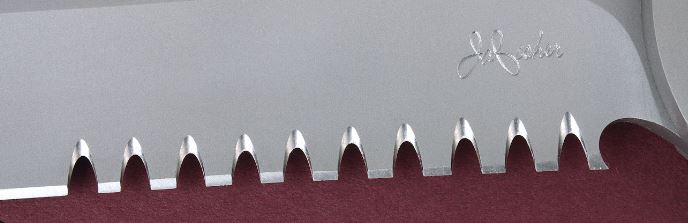
The following pattern to look at is the “Mixed Serration Pattern,” or what I like to call one to many patterns. Sometimes, this pattern is called a “Combination” or “Multi-Serration” edge. The advantage of this pattern is its versatility in cutting through more challenging materials. The large one serration provides for a more aggressive cutting, whereas the small ones offer finer control plus cleaner cuts on thinner materials. This pattern also provides for a more effective sawing capability.
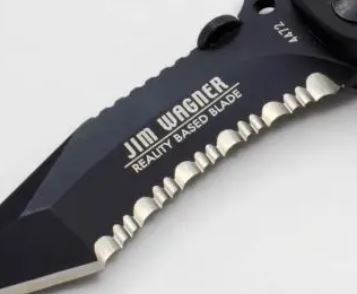
Both serration patterns create a series of high-pressure points that concentrate the cutting forces of the serrations. This makes them particularly effective on rigid, fibrous materials that might slip under the edge of a standard blade. The mixed pattern does more damage to connective tissue (Tendons, Ligaments, Fascia, Cartilage, etc.) when compared to other patterns or the standard blade.
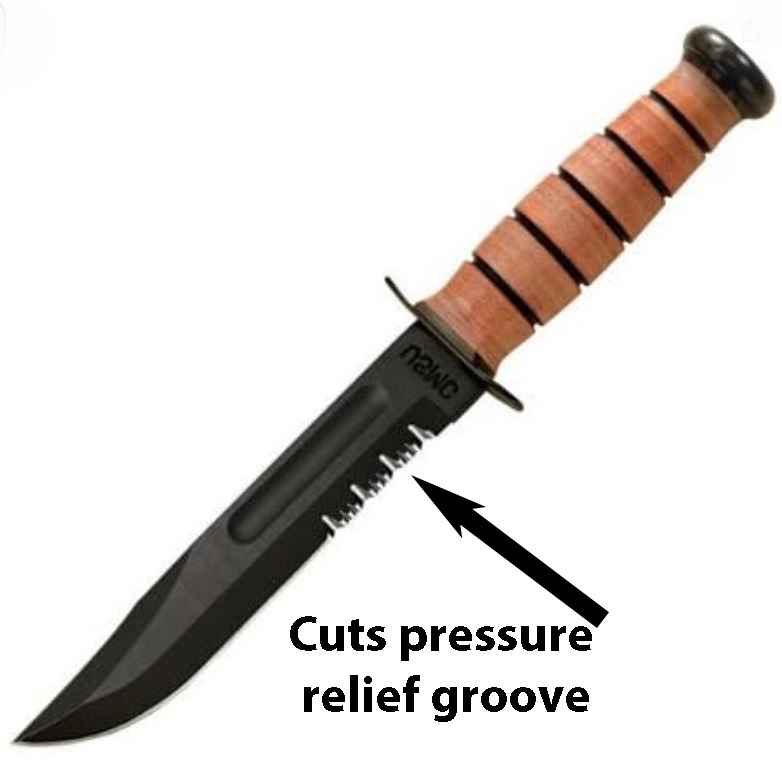
Personal note: I once got my standard blade stuck between two ribs and couldn’t get the blade back out. After that experience, I always used a blade with a serration pattern as it cuts a relief groove back out from between the ribs so your blade can be extracted.
Hand Guard
Some blades have them, and some don’t. This is a physical device that stops the attacker’s blade from running down your blade and onto your hand/fingers. They are sometimes called “Cross Guards,” as seen on many of the Bowie knife designs. They also keep your hand from slipping down the handle and running onto your own blade.
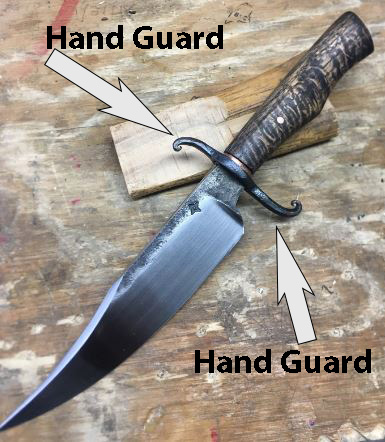
Remember our talk on the handle that it shouldn’t be slippery when wet? Well, as a last-ditch effort, a handguard could be used. However, they get in the way if you use a blade position forward or the blade in the reverse grip position.
The Handle
We have covered this topic in some detail, but I will remind you all about being non-slip and indexable here. These are essential features to have in a fighting knife, which will give you a great advantage over others who are not as skilled as you. One thing I didn’t mention was that G10 material gets “sticky” when wet.
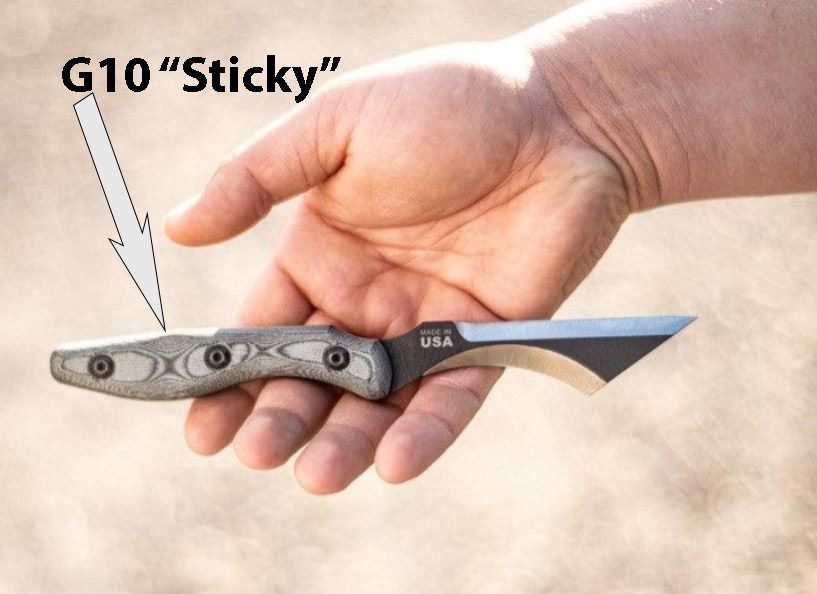
You can go to a knife shop and ask them about the non-slippery handle designs they have or materials. You will get a lot of talk about the designs cut into the handles, but you want non-slip. You can always ask them to get some cooking oil out or bring your own for them to use, have them pour it on the handle of their suggested purchase, and then have them slam it down onto a cutting board.
Yeah, right. I think you will hear all the excuses out of them as you could imagine. But, make no mistake about it, that is what we face out on the street in a fight. You don’t want to be fighting for your life and proceed to miss a target, hit their motorcycle helmet, and have your hand slide down onto your own blade. This stuff is essential to understand.
One last thing before I leave this topic. I put grip tape on my knives and guns, too. You can get this on Amazon.com. Once you choose a knife, put grip tape on your personal or everyday carry or EDC.
The Pommel
The pommel is the very end of the handle of your knife. It is a great place to have a glass breaker or some other hard metal spike, knob, or rectangle to be used as a weapon. You can use this area to strike down on grabbing hands or even heads. Most fixed blades have something in this area, but not all folder knives do. The one folder I suggest does; however, there are others out there. So, perhaps the checklist should handle and dump first, then figure out the rest?
Two types of Knives
Fixed Blades
Most of us are familiar with fixed blades like hunting or camping knives. They usually fit in a holster made from leather or, nowadays, Kydex holsters. The most important part of a fixed blade is its intended purpose. Again, is it hunting or camping? Perhaps it is survival or knife fighting? You might be looking for a combination of these areas of interest, and it is crucial to define them prior to looking for that knife.
Some survival knives have a big blade, saw teeth on the top, holes for determining distance, and all kinds of nifty things. The handle is full of other survival gear like matches, twine, fishing hooks and lines, and a small compass, perhaps, but you get a handle stuffed with one-time-use survival equipment.
This can be a very nice thing to have, but one thing it isn’t is something we call a “Full Tang” design. That is where the blade goes all the way from the tip of the blade to the end of the handle. There are “Partial Tang and Rat Tail” designs, too, but they are out of the scope of this blog post.
I suggest a “Full Tang” design for durability, hammering, chopping, twisting, prying, and cutting strength. In close quarters combat, a heavier knife can have real advantages in delivering more energy per blow or stab. All that energy must be absorbed by the body, thus causing more damage.
Lastly, a fixed blade doesn’t need to be two feet long, either. Although it is nice to have the reach, you don’t need to carry such a “Crocodile Dundee” type blade. A four-inch-long blade can reach any interior target you might need to attack. Anything else is a waste of a knife and would make you need to carry a heavy knife everywhere with you. Perhaps never use it to defend against a human attacker.
The fixed blade that I recommend for personal combat is known as the Back Bite from Top Knives. That knife designer encompassed everything I have ever taught about what makes a good knife. He put those into a fixed blade, and it has some real physical shock value in it as well. It creates “a powerful visual psychic disincentive to attack you.”
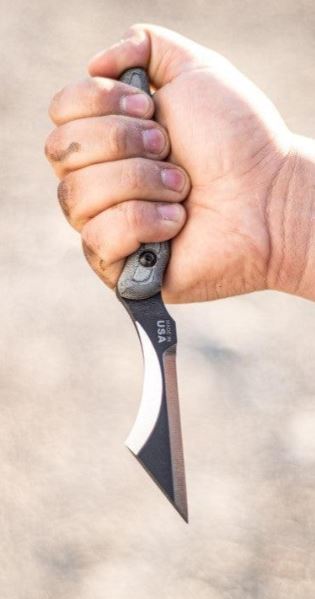
Figure 1 Back Bite Top Knives
You can check the resources section below for more information and links.
It has a tanto point, a straight blade where I have them put serrations on mine, and a talon section for cutting round things, like arms and legs. You get the idea. It takes far less time and energy to cut round things with a talon-shaped blade. It is full tang and has a G10 scales handle, which means it gets sticky when wet.
You can wear a fixed blade for your protection; this is a fine knife that will serve you well in your self-defense. Always check your local laws to see if you are allowed to carry such a tactical knife.
Folders
Just like Grandpa had a nice little pocketknife, they have grown up a bit today. Although you can find many of the old-time pocket knives for sale, we are not talking about them. The folders we are talking about are ones that you can fight another human for your life.
To that end, I should write a whole blog post on this subject, but let’s cut to the chase. Let’s get back to what we have learned already, which is what is essential in a knife choice. Remember, it’s the HANDLE! It is two things: first, it is non-slip, and second, it is indexable. Let me add one more thing when it comes to a folder: how it locks the blade into the using position.
This is called “Blade Lock,” or what method is used to lock the blade into the business end of the folder. There are various ways, and I’ll mention most of them so that you know, but the short of it is that I’m not too fond of liner locks but prefer frame locks. Here is a list of locking mechanisms that you can research on your own. They are Liner Lock, Frame Lock, Lockback, Axis Lock (Benchmade’s patent), Compression Lock (Spyderco’s design), Button Lock, Ring Lock or Collar Lock, and Tri-Ad Lock (Cold Steel’s design).
Each one of these blade lock methods has pros and cons, so you might want to research them before purchasing a folder. Having done this myself far too many times, I recommend the Jim Wagner Reality-based folder. I also want to make a disclaimer here: I get nothing for these recommendations. I carry this folder myself and am risking my life on this blade; that is how much I love this knife.
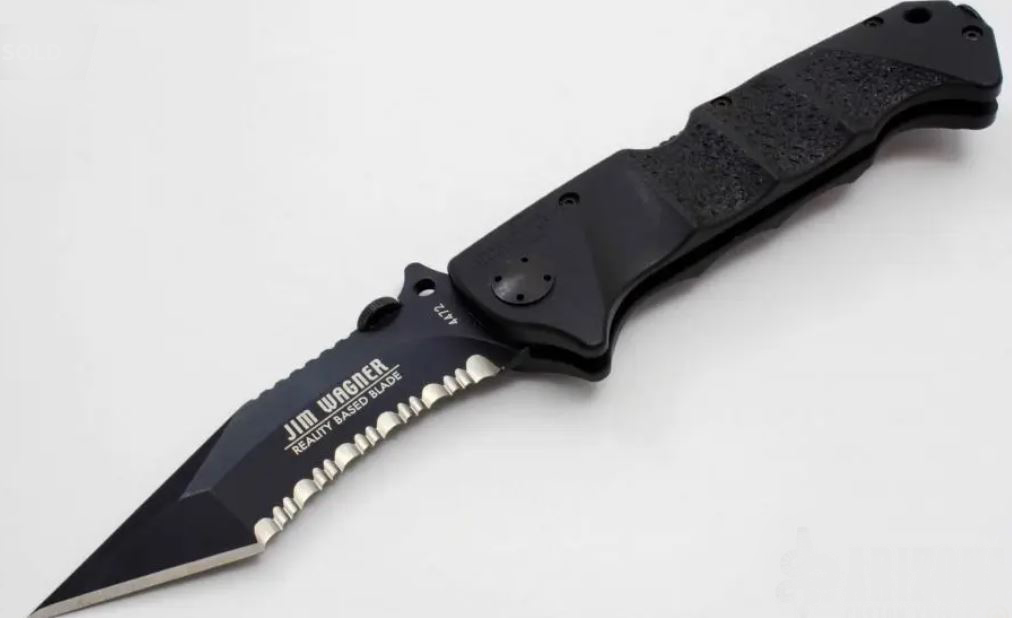
You can check the resources section below for more information and links.
Legal considerations:
This is a highly complex section to write precisely. I will write about general specifications, thoughts, and features. However, you MUST check with your state and local authorities on what is legal to carry in your area.
Legal considerations for carrying knives, without a doubt, vary widely from place to place. It is a very complex web to navigate, too.
In the USA, federal law generally allows for the carrying of folding blades under 2.5 inches long. In California, where I know a bit about it, they allow blades 3.5 inches or under! Go figure, but this shows the variance between places and, in this case, jurisdictions. However, much of what I wrote might not be correct, as I just checked on fix-blade laws in California. Dig this, and I’ll copy it directly:
“1. General Rule: In California, there is no specific length limit for fixed-blade knives that are carried openly.
- Concealed Carry: It is generally illegal to carry a concealed fixed-blade knife of any length in California.
- Open Carry: Fixed blade knives of any length may be carried openly in a sheath on the waist.
- Exceptions: There are some location-specific restrictions. For example:
– On school grounds (K-12), it’s illegal to possess any knife with a blade longer than 2.5 inches.
– Some cities or counties may have additional restrictions.
- Dirk or Dagger: California law prohibits the concealed carry of any knife that can be described as a “dirk” or “dagger,” which includes most fixed-blade knives.
- Intent: The intended use of the knife can be a factor in legal considerations.”
Now, it would seem that item 5 counteracts all the items above it! This is precisely why you need to research your local and federal laws in your area plus country.
One thing that is for sure is you can’t take knives in federal buildings, hospitals, bars, or anywhere there is TSA.
United Kingdom:
– It’s illegal to carry a knife in public without good reason unless it has a folding blade with a cutting edge 3 inches long or less.
Canada:
– No length restrictions, but prohibits carrying certain types (e.g., switchblades, butterfly knives).
Australia:
– Laws vary by state but generally restrict carrying knives without a lawful excuse.
It’s crucial to note that:
- Laws constantly change, and to that degree, you must frequently check to make sure you are operating with the most current laws on the books.
- God knows that the interpretation of laws varies all the time. Heck, lawyers argue the meaning of laws all the time, so be aware of this fact.
- Oddly enough, specific features of knives, e.g., locking mechanisms, opening methods, or the like, can affect legality.
- Another very odd thing is that lawyers say that self-defense is often not considered a valid reason for carrying a knife! OK. Who thought that up? I wonder if learning to defend yourself with martial arts is not a good reason to use it for self-defense?
This last item, number 4, is mind-blowing to me, but an old martial art is saying, “It is better to be tried by twelve than carried out by six.”
Psychological aspects
The shock value of a knife in your self-defense can turn the tables on the fight altogether. The more a tactical blade looks “Mean or Nasty,” the better. I have not mentioned one blade that has some good shock value, the “Karanbit.” I don’t use that blade, but many of my moves with the Jim Wagner blade indeed mimic some of the Karanbit moves. A talon blade looks a little dreadful and imposing on one’s intentions.
There can be a powerful visual psychic disincentive to attack you when they see that you are carrying a knife. A fixed blade in plane sight can be a bit scary for attackers who think you are just a pushover and, therefore, easy prey. When they see you are packing a weapon, they will think twice many times. It is a very powerful thing to change the dynamics of an attack by showing what you have to defend yourself.
On the other hand, having a concealed weapon can still work in your favor. The element of surprise can rapidly shift the dynamics of an attack. The bad guys didn’t think you were this capable of defending yourself. They have a tiger by the tail, and they are screwed to think you were easy prey. The first rule in combat is never to underestimate your opponent. Most bad guys are not schooled in warfare, but you can take a page out of the playbook with concealed carry.
When you decide to carry a knife, you must also consider the outcome of a fight. How are you going to feel when you seriously hurt another human being? I know it might sound trivial at this point, but the after-effect of the use of a blade is a sombering experience. It is only human to feel bad about a situation that leads to the injury of anyone. Take a car accident, for example. If you have a vehicle accident, you can feel wrong about the other party’s injuries, even if it is their fault. It’s only human to think that, and especially hours or days after the fact.
Take our military, for example; they kill someone or many, and at first, they can feel happy they won. Later, they ponder the entire event, and many wish they had never been put into that situation, even if they had volunteered for it. Thus, we have PTSD. I understand this as I have suffered from PTSD since 1973. But I still carry a knife and, many times, my Glock .40 Cal with mixed rounds.
One way to prepare to defend yourself is by visualizing the various attack events before you experience them in real life. This helps to program your mind on how to function and how to feel after the event. It can seriously help your Performance and your emotional control post-event.
Conclusion
This journey to pick the best self-defense knife is a personal journey. This article gave you many thoughts and features to consider when you are on your journey. Remember, most of all, the crucial element is a secure handle. You must or should prioritize a non-slip, comfortable, indexable handle that allows for confident control.
The blade design is also critical, and you learned about how a Tanto tip offers superior Performance. You should couple this with a chisel edge and serrations to make the most formidable knife possible. Also, consider that aspect of a full tang construction for fixed blades to maximize durability and impact force.
Regardless of whether you opt for a fixed blade or a folder, you must ensure that it aligns with your needs plus meets your local laws. Use visualization of potential scenarios to help you mentally prepare if you should need to use a knife for your life’s defense. Or, God forbid, the lives of your loved ones. The best self-defense knife is the one that you can handle proficiently plus deploy confidently when your safety is at stake.
Research the weapons laws in your country, state, and local area. Make sure that where you are traveling, you check their laws as well. You don’t want to be legal at home, then travel a few miles into another state to shop or visit just to find out you have a felonious weapon and get yourself in legal trouble.
Finally, remember that the best self-defense knife is the one you have in your hand, regardless of whether it follows the features of this article. Whatever knife you have is your best knife for your self-defense.
Master Peter Brusso
PDWS.biz
Resources
Website for good definitions and knives: https://www.knafs.com/pages/pocket-knife-blade-shapes
Another good source of information: https://www.knifecenter.com/
Jim Wagner Reality Blade: https://www.knivesplus.com/bokerknifejimwagner-bk-bo51.html
Top Knives: https://www.topsknives.com/back-bite
Jim Wagner video: https://youtu.be/fy7CHojcLCo
Bonus section:
Just as a reminder, when you research weapons laws, you need to look for things like “Defense Knives or Defense Knife,” as they are slightly different in spelling but, for us, mean the same thing. Also, check out “Blade Length, Pocket Clip, Folding Knife, Carry Knife, and Defensive Situation,” as these, too, put a spin on the law and what you can carry. If that wasn’t enough, look up “EDC Knife, Stainless Steel, Kydex Sheath or Leather Sheath” and add in “Steel Blade,” as these can all spin the results of what you can carry. See what I mean about crazy laws, which are difficult to navigate!
I also didn’t include any price information, as that changes constantly. One other manufacturer worth looking into is Kershaw, but I didn’t have enough space in this blog post to do them justice. They are a good knife manufacturer, too, so don’t exclude them from your search list.

