
The Defender One 2024


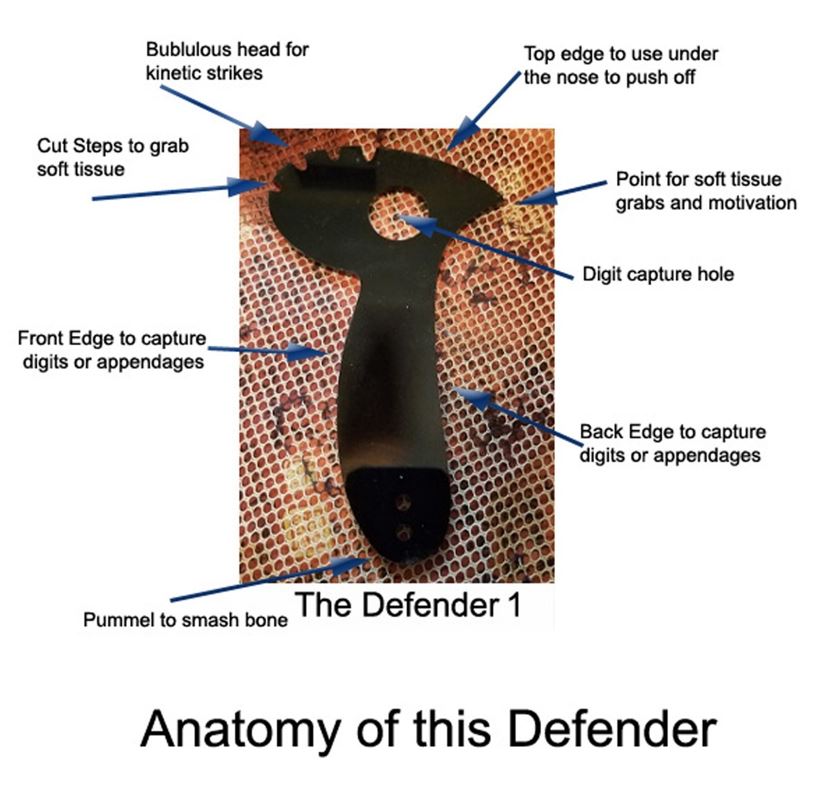


The Defender One
The Defender 1 was the third in the invention line. It had humble beginnings from the first of the defenders, the Guppy, and then the Rabbit. The Rabbit had two new features over the first Defender that I, Master Brusso, invented, and that was the Guppy.
The Rabbit introduced the saw tooth soft issue capture and the digit capture hole. These new features worked great, and the Rabbit’s pronounced nose made up the tool’s head. As we worked with these features, it was clear we couldn’t go through a TSA search.
Well, it did for years, but I wouldn’t do it as it has sharp saw teeth. However, what if we could design a soft tissue capture that would do the same thing as the saw tooth feature but without sharp points?
I went to work on some samples using various concepts. The winning design was the “Squares” cut into the head of a tool, a space cut down into the head that allowed the soft tissue a place to “slide down into.”
We loved the larger head with the cut-in squares, which were not evenly placed, as it turned out it was better at grabbing different shapes of soft tissue. The larger head added a striking capability to the tool.
Kinetic energy is the first line of defense with the Defender 1. You hold down on the handle and use it like a hammer. The reason it hurts so bad is that the Kinetic energy from the swing downward, when it hits a bony area, gets transferred to the attacker through a small surface area. The head of the tool is a quarter-inch thick, so all, and I mean all, the energy gets transferred to the target.
The Defender 1’s effectiveness comes from its ability to concentrate kinetic energy. When you swing it like a hammer, the small surface area of the head (about 1/16 inch by 1/4 inch) focuses all the impact energy into a tiny point. This concentration creates high pressure on the target area, making it extremely effective against bony parts of an attacker’s body.
The most common areas for attack are the backs of hands, collar bones, heads, and teeth, and it has even been used on eyeballs (ouch)!
Now, the point and claw on Defender 1’s back were also very new. We found this extremely interesting, as you can move a person around like a ragdoll by pushing the claw into the attacker’s soft tissue.
For example, in the bend of the elbow, which is from a front choke, either the attacker releases the choke or gets pushed to the ground by the pain. Another place for the claw application is behind the collarbone; this will put the attacker on the ground quickly. I remind you, this is all non-lethal, too!
You can even do weapons disarms by placing the claw in between the fingers and attacking the web of the fingers. You can pull the weapon right out of their hands, or in most cases, they drop it.
The digit capture hole became a priceless item on the Defender. Once you capture a finger or thumb, secure it with your grab on the Defender with their digit between the Defender and your grab; the fight usually stops almost instantly. You lift up to get the attacker on their toes or down to put them onto the ground. You can hold the attackers until the police or the like come to take over the situation.
Many of my students thought that feature would never be used in developing this digit capture capability. Why? I asked. Well, they said it would be darn near impossible to capture a digit during combat.
I set classes where we fought for about four hours per week, and in two weeks, we had a meeting to discuss our experiences.
As it turns out, the primary challenger of this feature was now a true believer. To prove him right, he specifically focused on trying to capture a finger or thumb. Guess what? Now, it is his favorite feature. He is a convert, but more importantly, he helped to develop the digit techniques that you will learn in the Free online, unlimited Defender training.
The pommel end can also be used to apply pressure to bony areas. You can strike the attacker with the pommel end, but remember that the pressure is transferred to the attacker’s body in a one-quarter-inch by 1/16-inch area. Ouch!
The tool is made of Acrylic and is 6.5 inches long and 4 inches at the head of the tool. It weighs 1.6 ounces.
Finally, the Defender 1 has lanyard holes for easy carry options. Let’s examine the feature list.
Key Features:
- Innovative “squares” design for effective soft tissue capture
- Large head for powerful striking capability
- Rear point and claw for attacker control and manipulation
- Digit capture hole for immobilizing attackers
- Pommel end for precise pressure point strikes
- Made from durable Acrylic material
- Compact size: 6.5 inches long, 4 inches at the head
- Lightweight: only 1.6 ounces
- Lanyard holes for easy carry options
- Non-lethal design focusing on pain compliance and control
- Versatile application against various types of attacks
- Access to free, unlimited online training resources
Any tool with sharp points cannot pass a TSA checkpoint. It is best to place your pointed Defenders in your luggage for check-on of any vehicle that requires TSA clearance.
This self-defense tool is extremely powerful and should only be used responsibly in genuine self-defense situations. Users must be familiar with and comply with all local, state, and federal laws concerning the use of a self-defense tool.
Additionally, it’s essential to review the TSA’s list of prohibited items on flights or similar regulations. Make sure also to understand the laws regarding the carrying of self-defense tools in any location where you intend to have them.
My tools, like those from Master Peter Brusso, are intended for ethical and legal use only, and this principle applies to all of my Defender products.

